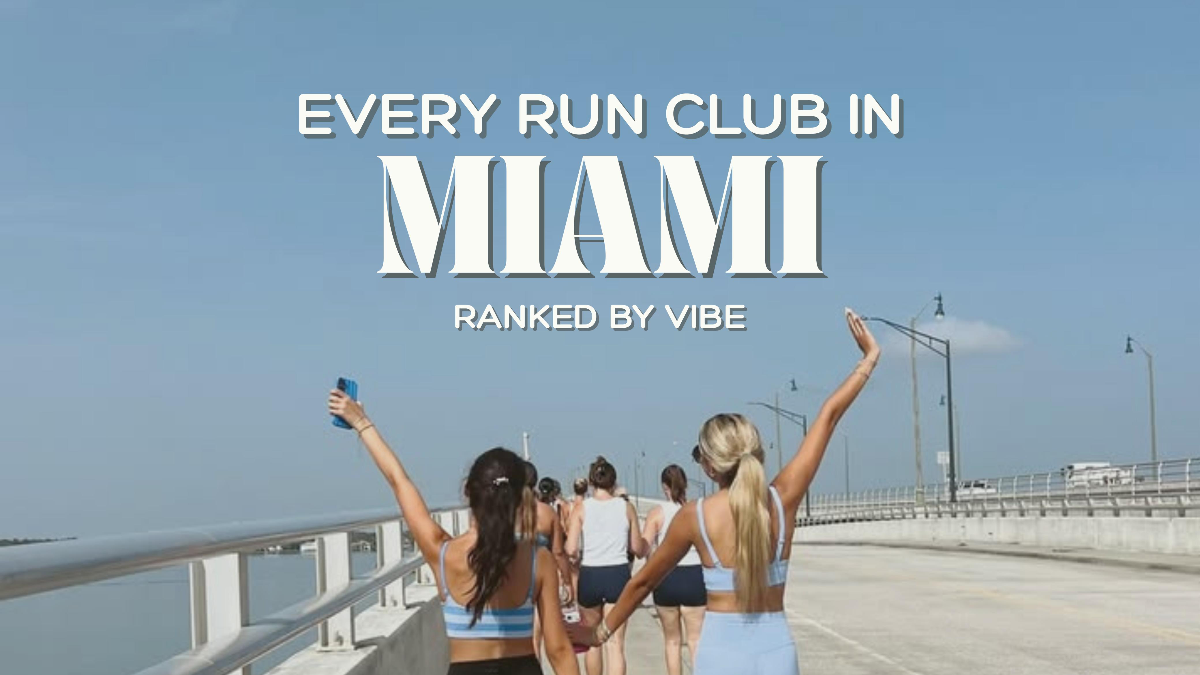
10 Run Clubs in Miami, Ranked by Vibe—not Pace
A run club can be a workout. In Miami, it is often a standing social appointment with a 5K attached.
Some groups attract hundreds of people, brand activations, photographers, and a crowd that stays long after the cooldown. Others feel like a neighborhood routine: the same park, familiar faces, an easy route, and coffee afterward.
That distinction matters more than most pace charts.
The best run club in Miami is not necessarily the fastest, largest, or most photographed. It is the one whose location, schedule, crowd, and social rhythm make you want to return the following week.
That is how this ranking works.
We reviewed current official listings, club websites, local business district pages, event calendars, and recent Miami coverage. The clubs are ranked by social atmosphere, beginner comfort, neighborhood identity, accessibility, and post-run potential—not by average mile time.
Schedules and meeting points can change. Check the club’s latest official announcement before leaving home.
Why Miami Run Clubs Have Become Social Clubs
Miami has no shortage of places to meet people. What it often lacks is an easy reason to see the same people repeatedly.
Run clubs solve that problem by placing social contact on a schedule. You do not need to invent a plan, coordinate ten calendars, or open a conversation with a stranger for no apparent reason. Everyone is already there to do the same thing.
That repeated contact can matter beyond exercise. The Centers for Disease Control and Prevention explains that social connection supports belonging, stress management, physical activity, and overall mental and physical health. The CDC also recommends joining groups organized around shared interests as one practical way to create stronger connections.
Miami’s current running scene includes large urban clubs, neighborhood crews, walker-friendly meetups, training programs, and groups built around specific communities. A recent local directory identified clubs operating from Brickell and Coral Gables to Kendall, Miami Beach, Little Havana, Coconut Grove, and Palmetto Bay.
The question is no longer whether Miami has a run club. It is which one fits the way you want to spend a weekday evening or Sunday morning.
Miami Run Clubs at a Glance
For the largest crowd and strongest social energy, start with Brickell Run Club.
For waterfront routes and a neighborhood-centered crowd, try Coconut Grove Run Club.
For local identity and community involvement, choose Run Little Havana.
For a central Downtown Miami meetup, look at Motion MIA.
For walking options and several ways to participate, consider Miami Run Club.
For an LGBTQ-friendly run on Miami Beach, explore Miami Gay Run Club.
For a more organized and polished weekly format, try Gables Run Club.
For an accessible neighborhood group in South Miami-Dade, look at Kendall Run Club.
For a smaller West Kendall community, choose West Kendall Run Club.
For faith, accountability, and a more intimate group, consider EnRoute Run Club.
Now, the full ranking.
1. Brickell Run Club: Best for Big Social Energy
The vibe: High-volume, outgoing, urban, visible
Best for: Newcomers who want plenty of people to meet
Potential drawback: The crowd may feel overwhelming if you prefer smaller groups
Brickell Run Club is the obvious starting point for anyone who wants a run to feel like an event.
The club meets at 1300 Brickell Avenue for a free Tuesday evening run through Brickell and Downtown Miami. The official Miami Downtown Development Authority listing describes a typical distance of approximately 3 to 3.5 miles, with the event operating rain or shine.
The social advantage is scale. You are not walking into a group of twelve regulars who already know one another. A larger turnout creates more entry points: pace groups, warmups, conversations before the start, and people lingering afterward.
It is also one of the stronger options for someone who has recently moved to Brickell and wants a recurring plan close to home. Our neighborhood guide to run clubs in Brickell can help you compare local options without searching across multiple event platforms.
Brickell Run Club is less suited to someone looking for silence, anonymity, or a tightly coached workout. The atmosphere is social, energetic, and distinctly Brickell.
Who Will Like It
Choose Brickell Run Club if you enjoy large groups, do not mind introducing yourself, and want a Tuesday plan that can lead to dinner, drinks, or another event afterward.
Arrive early. In a large crowd, the conversations before the run are often easier than trying to find someone after everyone finishes.
2. Coconut Grove Run Club: Best for Neighborhood Energy
The vibe: Social, outdoorsy, local, coffee-after compatible
Best for: Grove residents and runners who prefer waterfront surroundings
Potential drawback: Meeting locations and formats may vary
Coconut Grove Run Club feels more connected to its neighborhood than to Miami’s broader fitness scene.
The surrounding area gives the group a natural advantage: waterfront parks, tree-lined streets, outdoor restaurants, and several places where a morning or evening run can continue into breakfast or coffee.
The Coconut Grove Business Improvement District describes the club as open to everyone from beginners to marathon runners and presents it as part of the Grove’s broader community fitness culture. The district has also profiled the people behind the club and their emphasis on building community through movement.
This is the group for someone who wants the run to feel like part of neighborhood life rather than a separate fitness appointment.
The crowd can be energetic, but the Grove itself softens the atmosphere. There is less office-district intensity and more room for the morning-run-to-brunch sequence.
Who Will Like It
Choose Coconut Grove Run Club if you live nearby, prefer scenic routes, and want to meet people who are likely to return to the same cafés, parks, and local events.
Because the club has used different routes and meeting points, confirm the latest instructions through its current official channel before attending.
3. Run Little Havana: Best for Community and Local Identity
The vibe: Inclusive, neighborhood-rooted, culturally specific
Best for: Runners and walkers who want community beyond the weekly route
Potential drawback: The standard distance may feel short to mileage-focused runners
Run Little Havana is not simply a group that happens to meet in Little Havana. The neighborhood is central to its identity.
According to the official Run Little Havana website, the group focuses on accessible fitness, community-building events, and health empowerment activities. Its recurring Wednesday meeting begins at 7 p.m. at Domino Park on Calle Ocho, with additional events organized alongside local businesses.
That mission changes the atmosphere.
The run is not positioned as a test of speed or endurance. It is an entry point into a neighborhood community. Walkers, newer runners, local residents, and people coming from elsewhere in Miami all have a clear reason to participate.
Run Little Havana has also expanded into activities such as neighborhood cleanups and partnerships with community organizations, reinforcing that its purpose extends beyond weekly mileage.
Who Will Like It
Choose Run Little Havana if you want an approachable distance, strong neighborhood character, and a group that treats community involvement as part of the club rather than a side project.
It is also a practical choice for someone who worries about being left behind. The run-and-walk format lowers the barrier to joining.
4. Motion MIA: Best for Downtown Newcomers
The vibe: Central, modern, accessible, low-pressure
Best for: Downtown residents who want a straightforward weekly 5K
Potential drawback: The retail-district setting may feel less intimate
Motion MIA meets in one of the most convenient locations for people living around Downtown Miami, Park West, or Miami Worldcenter.
The official Miami Worldcenter event listing describes a Wednesday evening community 5K meeting at lululemon. All paces are welcome, and the event is explicitly positioned around movement and community rather than competitive training.
The appeal is simplicity.
The location is central, the format is easy to understand, and the group invites people to arrive alone. That makes it a useful first run club for someone who has never joined one and does not want to decode a complicated training program.
Miami Worldcenter’s 2026 anniversary event for the club also included a one-mile walk, recovery support, refreshments, and time to connect after the route—good indicators of a group that considers the social portion part of the experience.
Who Will Like It
Choose Motion MIA if you want a reliable Downtown meetup with a defined distance and a clear newcomer-friendly format.
It is particularly useful for residents who want to avoid driving across Miami for a run that begins after work.
5. Miami Run Club: Best for Flexible Participation
The vibe: Broad, social, fitness-oriented, accommodating
Best for: People who want walking and running options
Potential drawback: The experience may differ depending on the weekly meetup
Miami Run Club is one of the better options for someone who wants more flexibility than a single weekly 5K.
The club describes itself as a fitness and wellness community focused on meaningful relationships and an inclusive atmosphere. Its public materials emphasize weekly meetups, group fitness, socialization, and participation across different experience levels.
At Miami Worldcenter, the club’s Tuesday event includes a choice between a one-mile walk and a three-mile run, along with a guided warmup. The event listing specifically identifies networking and community as part of the experience.
That walk option matters. Many people avoid run clubs because they assume they must maintain a continuous 5K pace. A clearly advertised walking route removes that uncertainty.
Who Will Like It
Choose Miami Run Club if you are rebuilding fitness, bringing a friend with a different pace, or want a group where walking is presented as a standard option rather than an exception.
Check the specific event before attending, since the club has hosted activities at multiple Miami locations.
6. Miami Gay Run Club: Best for LGBTQ+ Community on Miami Beach
The vibe: Casual, affirming, social, beach-adjacent
Best for: LGBTQ+ runners and allies looking for an inclusive environment
Potential drawback: Crossing to Miami Beach can be inconvenient during traffic
Miami Gay Run Club offers something more specific than a general all-paces label: an LGBTQ-friendly community where the social context is clear before anyone arrives.
Current club listings describe casual weekly runs beginning near Lincoln Road and Bay Road, with adjustable distances and paces. The group is open to different skill levels and emphasizes connection and enjoyment rather than rigid performance standards.
The Miami Beach location also gives the group access to some of the city’s most recognizable running areas. The official Greater Miami guide to local running routes highlights the Beachwalk and South Pointe area for their flat waterfront paths and ocean views.
Who Will Like It
Choose Miami Gay Run Club if an explicitly LGBTQ-friendly environment would make it easier to arrive alone, introduce yourself, and return consistently.
As with any group using public urban routes, confirm its latest meeting instructions before traveling to Miami Beach.
7. Gables Run Club: Best for an Organized Weekly Routine
The vibe: Structured, polished, steady
Best for: Coral Gables residents who want predictability
Potential drawback: Less spontaneous than Miami’s larger social clubs
Gables Run Club is a strong fit for people who prefer a defined weekly routine over a large, unpredictable crowd.
Current listings describe free Wednesday evening runs through Coral Gables, with approximately 3.5-mile routes, group pacing, warmups, water, and participation for walkers and beginners.
The atmosphere is social, but the structure gives it a more organized feel. You arrive, warm up, identify the appropriate group, complete the route, and reconnect afterward.
That can be reassuring for first-time participants who dislike events where nobody seems to know where to stand or what happens next.
Who Will Like It
Choose Gables Run Club if you live near Coral Gables, prefer an established format, and want enough organization to reduce first-visit uncertainty.
It is also a practical alternative for runners who like the Brickell model but do not want to travel into Downtown Miami.
8. Kendall Run Club: Best for No-Fuss Consistency
The vibe: Practical, welcoming, neighborhood-based
Best for: Kendall residents who value convenience over spectacle
Potential drawback: Less nightlife and post-run activity within walking distance
Kendall Run Club is proof that a useful community does not need to become a major lifestyle production.
Current information describes a free weekly group with varied routes, several pace options, shorter alternatives, and participation from more experienced runners as well as beginners and walkers.
The primary advantage is geographic.
A Kendall resident is more likely to build consistency with a nearby weekly group than with a club that requires a long drive into Brickell or Miami Beach. Proximity makes it easier to attend on an ordinary Wednesday, including the weeks when motivation is low.
Who Will Like It
Choose Kendall Run Club if your priority is a dependable local routine, accessible distances, and people you can realistically see again outside the event.
This may not be the club for maximum social visibility. It may be the better club for forming consistent neighborhood relationships.
9. West Kendall Run Club: Best for Local Regulars
The vibe: Familiar, inclusive, low-pressure
Best for: West Kendall residents and walkers
Potential drawback: Limited appeal for people outside the area
West Kendall Run Club serves a similar purpose to the Kendall group but with an even more specific local radius.
Current listings describe free Thursday runs beginning near West Kendall Baptist Hospital, with flexible routes of approximately 3 to 3.5 miles and shorter or longer adjustments. Walkers and beginners are welcome.
The smaller geographic focus can be an advantage.
Large citywide groups create more introductions. Neighborhood groups create a higher probability that participants live, work, shop, or exercise near one another. That makes follow-up plans easier.
Who Will Like It
Choose West Kendall Run Club if you want a familiar weekly group close to home and have little interest in driving forty minutes for a more fashionable location.
The value here is not novelty. It is repeatability.
10. EnRoute Run Club: Best for Small-Group Accountability
The vibe: Faith-based, intentional, intimate
Best for: Runners seeking accountability and shared values
Potential drawback: Its religious focus will not suit everyone
EnRoute Run Club has a narrower identity than most groups in this guide.
Current listings describe it as a faith-based club centered on running, Christian worship, discipline, accountability, and community. Its activities have included road, park, and trail-based sessions around Palmetto Bay.
That specificity is useful. A clearly defined club may attract fewer people, but participants already know that they share more than an interest in running.
For someone seeking a smaller group and stronger accountability, that can be more valuable than a large anonymous turnout.
Who Will Like It
Choose EnRoute Run Club if its faith-based mission aligns with your values and you prefer a more intentional group over Miami’s larger social scenes.
Check the current schedule carefully because its sessions may not follow a standard weekly format.
Specialized Miami Running Groups Worth Knowing
Not every running group should be evaluated like a casual social club. Some have narrower membership requirements or are built around specific training goals.
Team FDC: For Marathon Training
Team FDC is structured around preparing runners for the Miami Marathon and Half Marathon rather than providing a casual drop-in run.
Current information describes paid training plans and a more formal program format. It is better suited to runners who want coaching, accountability, and a race-specific calendar.
Choose it when the training plan matters more than the post-run social scene.
University of Miami Running Club: For Students
The University of Miami Running Club is designed around campus participation, weekly runs, longer weekend mileage, and student friendships.
It belongs in the broader Miami running landscape, but it is not a general public option.
The Herd: For Creative and Inclusive Community Energy
The Herd received significant local attention for its inclusive atmosphere, creative community, multiple pace groups, and work with the Push On Foundation.
Axios Miami profiled the club’s emphasis on belonging and its effort to create an environment where participants with different abilities could take part.
Because its widely available local coverage is older than the schedules used elsewhere in this guide, confirm its current status and meeting details before attending.
Which Miami Run Club Is Best for Beginners?
The strongest beginner options are not necessarily the slowest clubs. They are the groups that remove uncertainty.
Look for:
- A published distance
- Clearly identified pace groups
- An explicit walking option
- A warmup or orientation
- A no-drop policy
- A visible meeting point
- A post-run gathering where conversations can continue
Miami Run Club is one of the clearest choices for walkers because its Miami Worldcenter event openly offers a one-mile walk.
Run Little Havana also has a short, accessible format and a stated focus on inclusive community fitness.
Gables, Kendall, West Kendall, Coconut Grove, and several other local groups publicly welcome beginners or walkers. Current club directories indicate that most established Miami groups do not require a paid membership or previous racing experience.
Do not assume you need to run the entire route simply because the event is called a run club. Check the event details, contact the organizer when necessary, and choose a format that gives you room to participate comfortably.
How to Choose the Right Run Club in Miami
Start With Location, Not Reputation
A famous club across the city is less useful than a solid club ten minutes from home.
Miami traffic turns small social commitments into logistical decisions. Choose a group you can attend on a normal weekday—not only when your calendar, energy, and commute happen to align.
Decide How Much Crowd You Want
Brickell is better for volume and variety. A smaller neighborhood group is better for remembering names.
Neither atmosphere is inherently more social. They create different kinds of interaction.
Large clubs provide more introductions. Small clubs provide more repetition.
Check What Happens After the Run
A group can call itself social and still disperse the moment the route ends.
Look for coffee walks, refreshments, happy hours, stretching sessions, restaurant partnerships, or members who remain in the meeting area afterward. Those extra thirty minutes are often where people move from familiar faces to actual plans.
Attend More Than Once
Your first visit measures how it feels to be new. It does not necessarily measure the group.
Return at least twice before deciding that a club is too closed, too large, too serious, or not your crowd. Recognition changes the experience quickly.
Pick the Club You Can Join Consistently
The best club is the one that becomes part of your week.
Sevenish is building a more direct way to discover run clubs and social running experiences in Miami based on location, interests, and the kind of group atmosphere you prefer.
Is It Normal to Join a Miami Run Club Alone?
Yes. It is also one of the easiest ways to use a run club properly.
Arriving alone gives you a reason to speak to other participants instead of remaining attached to the person you brought.
Use a simple first-visit approach:
Arrive 15 minutes early.
Tell an organizer it is your first time.
Ask which group is best for your current pace.
Speak to one person before the start.
Stay for at least ten minutes after finishing.
Ask someone whether they attend every week.
You do not need to leave with five phone numbers. The objective is to make the second visit easier than the first.
Running Safely With a Group in Miami
Group participation does not remove the usual risks of urban running.
The Road Runners Club of America recommends clear routes, participant sign-ins, pace identification, compliance with traffic signals, running no more than two abreast, and ensuring that nobody experiencing a health problem is left alone. It also advises organizers to explain terrain, weather conditions, and hydration availability before departure.
Miami heat adds another consideration.
The CDC’s guidance for athletes exercising in hot weather recommends scheduling activity during cooler hours when possible, beginning gradually, drinking water before thirst develops, monitoring other participants, and stopping if weakness or faintness occurs.
Before attending:
- Review the route and distance.
- Check the forecast and current heat alerts.
- Bring water when the organizer does not provide it.
- Wear visible or reflective clothing for evening runs.
- Keep enough phone battery to use maps or contact someone.
- Follow traffic signals even when the runners ahead continue.
- Tell an organizer if you plan to turn back early.
- Stop when something feels medically wrong.
Sevenish members can review how the platform approaches safety for local experiences before attending an event. People using the platform can also read the Sevenish privacy policy for information about account and personal-data practices.
Why Sevenish Is Covering Miami Run Clubs
Sevenish is built around a simple premise: meeting people is easier when there is a specific plan, public location, and shared reason to show up.
Run clubs already provide that structure.
They create recurring contact without forcing every participant to be an experienced runner, a skilled networker, or the person responsible for organizing the entire plan.
That is also why Sevenish was created: to connect people through real local experiences instead of leaving potentially compatible strangers inside an endless messaging thread.
Run clubs are only one part of that system, but they are a useful one. The plan is clear, the group is public, and next week’s follow-up is already on the calendar.
FAQs About Run Clubs in Miami
What are the best run clubs in Miami?
Brickell Run Club is one of the strongest options for a large social crowd. Coconut Grove Run Club is better for neighborhood atmosphere and waterfront surroundings. Run Little Havana stands out for local identity and community programming, while Motion MIA provides a convenient Downtown 5K.
The best choice depends on where you live, the size of group you prefer, and whether you want a structured workout or a social plan with running included.
Are there beginner-friendly run clubs in Miami?
Yes. Miami Run Club, Run Little Havana, Gables Run Club, Kendall Run Club, West Kendall Run Club, Coconut Grove Run Club, and several other groups welcome beginners, walkers, or different pace levels.
Confirm whether the event has a walking group, no-drop policy, or shortened route before attending.
Are Miami run clubs free?
Many of Miami’s recurring social run clubs are free. Some training programs, track sessions, races, or special events charge a fee.
Current local listings indicate that most general community groups do not require paid membership, while structured marathon programs are more likely to charge.
Which run clubs in Miami allow walkers?
Miami Run Club publishes a one-mile walk option at its Miami Worldcenter event. Run Little Havana also uses an accessible run-and-walk format.
Gables, Kendall, West Kendall, and Coconut Grove are among the clubs identified in current listings as welcoming walkers.
What should I wear to a Miami run club?
Wear clothing suitable for heat and humidity, running shoes you have already used, and reflective gear for evening routes.
Bring water unless the event clearly states that hydration is provided. A small towel and a dry shirt can also be useful during warmer months.
Can I join a Miami run club without knowing anyone?
Yes. Most clubs are structured for public participation, and arriving alone is common.
Get there early, introduce yourself to an organizer, identify the appropriate distance or pace group, and remain after the run long enough to speak with other participants.
Are there run clubs in Brickell?
Yes. Brickell Run Club hosts a large recurring evening run in the neighborhood, and additional groups or branded running events may operate around Brickell and Downtown Miami.
Use the Sevenish guide to Brickell run clubs and local running experiences to compare neighborhood options.
Are there LGBTQ-friendly run clubs in Miami?
Miami Gay Run Club provides an LGBTQ-friendly running community on Miami Beach and welcomes runners across different experience levels.
Other general Miami clubs also describe themselves as inclusive, but an explicitly LGBTQ-centered group may offer a more immediate sense of context and belonging.
Do Miami run clubs meet during the summer?
Many do, often in the early morning or evening to avoid the hottest part of the day.
Summer weather may cause cancellations, route changes, delayed starts, or shorter runs. Check the organizer’s latest post before leaving and follow CDC heat-safety recommendations.
Find the Run Club You Will Attend Again
Do not choose solely by follower count, matching shirts, or how the event looks in a thirty-second video.
Choose the club whose location is realistic.
Choose the crowd where you can speak without performing.
Choose the route you can complete without dreading it.
Choose the weekly plan that leaves enough room for coffee afterward.
The first run introduces you to the group. Returning is what gives the group a chance to become part of your life.
Explore run clubs and running experiences in Miami through Sevenish and find a plan based on more than distance and pace.
Sevenish is launching in Miami first. Join the waitlist and be there from day one.
Join the Waitlist